


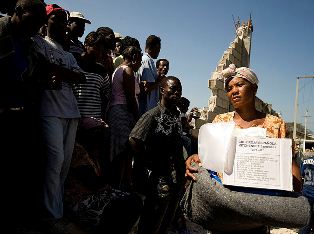
 Is Haiti on the road to some semblance of recovery, three and a half years after the mind-boggling, deadly and monstrous earthquake that struck in January 2010?
Some figures compiled by the International Organization for Migration, Oxfam and other international organization suggest the answer is a qualified yes. But before we declare the global and Haitian national reconstruction effort to be irreversible and well on its way, we should pause and insist that more needs to be done quite quickly, especially in the areas of housing, security and economic development.
When the IOM announced less than a week ago that 279,000 Haitians were still living in squalid conditions in tent cities, most of them in and around Port-au-Prince, the capital, the news was an improvement over the 360,000 displaced persons living hand to mouth in almost 500 tent camps in January this year, the third anniversary of the calamity. Clearly, it was a far cry from the 1.5 million Haitians left homeless after earthquake had pummeled the nations but such a large number is obviously untenable.
The international community, especially donor nations and individuals from around the world have earmarked almost $10 billion in assistance to help put Haitians back on their feet and improve living conditions but quite frankly there is more, much more that should have done to help the homeless, those who suffered serious injuries and to rebuild the country's infrastructure and the economy which suffered significant damage.
There is enough blame to go around, beginning with the international community which earmarked large sums of money at door conferences but took back much of the money to reimburse their treasuries for humanitarian activities they undertook after the act of nature left a trail of devastation across Haiti. A report of the Center for Global Development indicated that about a third of $ 6 billion set aside by to help in the rebuilding drive actually went back to the donors to reimburse them for their own civil and military work in Haiti. Much of the remainder reportedly went to international NGOs and private contractors to finance their Haitian operations. If accurate, those figures illustrate what's tragically wrong with the reconstruction of Haiti. Here was a dreadful situation that needed urgent and selfless responses but far too many donors seemed more interested in getting their share of their own money and NGOs taking their cut of the assistance instead of moving swiftly to help the economically and socially disadvantaged souls.
After all, Haiti was the Western Hemisphere's poorest nation where more than 40 per cent of the population existed below the poverty line, long before the act of nature impoverished so many people. It was as if every ounce of humanity was drained from the relief effort and siphoned off into less noble pursuits. It seemed to be a reflection of international greed and galloping and unbridled selfishness.
Although Haitian government officials aren't far wrong when they complain that less than 10 per cent of the humanitarian relief funds went to the government and that a mere one per cent of assistance was set aside for Haitian social services institutions and business, people there must shoulder some of the blame for the failures. Inefficiency and callousness took a painful toll on initiatives to relief people's suffering. Just as bad the current and previous administrations were far too slow in putting concrete and transparent initiatives in place to reduce the suffering, cut much of the chaos and return the country to some semblance of order.
That's why it didn't come as a surprise when the United Nations called on President Michel Martelly and his ministers to accelerate the pace of reconstruction and to do more to protect people's human rights. Martelly came to office pledging to cut the suffering almost immediately but it's clear that he hasn't lived up to his word.
But there were some extenuating circumstances to this awful situation. Not long after the earthquake which took more than 250,000 lives; left more people homeless than there are people in Barbados, St. Lucia, Antigua, Grenada, Dominica, St. Vincent & the Grenadines and their Eastern Caribbean neighbors put together; and caused billions of dollars in infrastructural damage, a cholera epidemic erupted causing the deaths of almost 8,000 people. The health care calamity was traced to United Nations troops brought to the country to maintain law and order but ended up unleashing a deadly disease that Haiti hadn't experienced in more than a century.
As if those tragedies weren't enough, floods and hurricane-force winds washed away roads and bridges, destroyed food crops and polluted rivers and streams, major sources of drinking water. Haiti has had more than any fair share of difficulties, certainly more than any of its better-off Western Hemisphere neighbors.
What's needed is better coordinated action that would quicken the pace of re-development. The situation demands a more humane and collective approach to the problem by the international community and the Haitian government. For one thing, donor countries must link arms with Haitian institutions and stop treating them as if they were step-children in their own country. There is also a need for greater transparency in government operations that would eliminate the suspicions that abound about corruption there. The public sector and civil society must act in a way that inspires confidence in national institutions. International NGOs that act as if they are a law unto themselves in Haiti must be reined in by the foreign governments that supply them with the funds that keep their executives in Haiti living in grand style without recognizing that they are accountable to Haitians, in or out of the government or the private sector.
That may appear to be a tall order but it's the only solution to the indifference and the neglect that are commonplace in Haiti.
Portland and Seattle
Free Subscription to Breaking News
Free Subscription to Breaking News


